
Product Description
445 Class Pintle Chain with A1 attachment
Product Description
The 400 Class Pintle Chains(442/445/452/455/462/477/477/4103/4124) is a lightweight,moderately priced chain capable of handling average loads at slow or intermediate speeds. It is proportionately cast for balance, strength and long, efficient service, and is available in riveted or cottered construction. The head of each pin is notched to fit the sidebar locking lug which keeps the pin from rotating when the chain is in use. Closed bearing construction makes 400 Class Pintle Chain useful in conveying moderately gritty and CHINAMFG materials.
Manufactured in HZPT Company, with a tensile strength range from 7,800 to 32,500pounds, The 400 Class Pintle Chain is carefully cored for pitch accuracy with smooth bearing surfaces that reduce “break-in” wear causing pitch elongation. 400 Class Pintle Chain is available in a pitch range of 1.375 to 4.060 inches with a complete assortment of Brutaloy or cast steel sprockets.
|
Moline Chain NO. |
Weight Per Foot Pounds |
Dimensions in Decimal Inches |
|||||||
|
A |
C |
D |
E |
F |
G |
H |
T |
||
|
445-A1 |
1.8 |
15/32 |
15/16 |
1/4 |
7/8 |
7/16 |
3/8 |
3/4 |
3/16 |
|
Moline Chain NO. |
Pitch in Inches |
Links Per |
Weight Per Foot Lbs |
Average Ultimate Strength Lbs |
Allowable Chain Pull Pounds Lbs |
Available Attachments |
|
145 |
1.630 |
74 |
1.0 |
6400 |
780 |
E1 K1 F2 |
|
434 |
1.398 |
86 |
1.0 |
5600 |
720 |
|
|
442 |
1.375 |
88 |
1.4 |
7800 |
1000 |
K1 |
|
445 |
1.630 |
74 |
1.5 |
7800 |
1000 |
K1 F2 |
|
452 |
1.506 |
80 |
2.0 |
9100 |
1250 |
A88 D5 E1 K1 |
|
455 |
1.630 |
74 |
1.9 |
9490 |
1260 |
A1 A3 K1 F2 F21 M1 |
|
462 |
1.634 |
74 |
2.5 |
11700 |
1800 |
A12 G1 K1 F2 |
|
477 |
2.308 |
52 |
2.0 |
12480 |
1640 |
A22 A11 D5 G1 G19 K1 F2 F6 F19 |
|
483 |
4.000 |
30 |
2.9 |
14300 |
2460 |
A22 |
|
488 |
2.609 |
46 |
9 |
14300 |
2130 |
G6 H19 K1 K2 F2 M1 |
|
4103 |
3.075 |
39 |
5.7 |
28600 |
4200 |
A22 A42 G6 K1 K2 F2 F29 M1 |
|
4124 |
4.063 |
30 |
8.5 |
92800 |
5500 |
K2 F8 |
Company Profile
The company has advanced manufacturing technology and relatively strong manufacturing force, and high-end precision testing instruments to ensure that every chain leaving the factory is qualified. The company mainly deals in: transmission chain, transmission chain, lifting chain, agricultural machinery chain, stainless steel chain, etc. Various non-standard chains are ordered separately. The company uses more than 600 kinds of non-standard molds. It can be customized according to drawings. We implement all-round management and control over product quality and service, and constantly improve customer satisfaction. The chain produced by the company enjoys a certain reputation in the world with its high quality, good reputation and high-quality service.
Related products
The chain types are divided into engineering chain, conveying chain, plate chain, transmission chain, escalator chain, parking equipment chain, agricultural chain, stainless steel chain, etc. There are different types of chains with different purposes, specifications, models and styles.
| Plate chain type Plate chain is usually used to lift goods. For example, forklift, lifting machinery and equipment. Plate chain has no rollers, but chain plates are connected with each other. It is a kind of chain used for loading. Different types of plate chains have different functions, | Stainless steel chain Stainless steel chain types include standard stainless steel chain, stainless steel hollow pin chain, stainless steel chain used for environmental protection equipment, etc, |
| Type of transmission chain Many types of transmission chains are power transmission chains, such as precision roller chains, double pitch roller chains, high-strength short pitch precision roller chains, petroleum chains, pumping unit chains, self-lubricating roller chains, side bending (turning machine) chains, corrosion resistant chains, etc | There are many types of escalator chains, including escalator step chains, heavy-duty high gradient escalator step chains, travelator chains, and escalator chains of different specifications and models,
|
| The engineering chain includes many kinds of chains, such as cement bucket elevators, environmental protection equipment, pavers, trenchers, welding equipment, mining, power plant dust removal and other equipment. |
Agricultural machinery chain Agricultural machinery chain is a chain developed and produced according to the characteristics of different crops, including rice harvester chain, GS38 combine chain, corn harvester chain, citrus straw harvester chain, soybean harvester chain, peanut harvesting chain, garlic sowing chain, and potato planter chain. |
| There are many types of conveying chains, such as wood conveying chain, double speed chain, RF conveying chain, sharp tooth chain, sugar chain, brown oil chain, F chain, metric conveying chain, top roller conveying chain, grain scraper, hollow pin, suspension conveying, etc. The conveying chain is a power chain for transporting goods. | Parking equipment chain This type of chain includes roller chains for parking equipment, chains for vertical circulation parking equipment, and parking equipment chains that can be developed according to demand. |
We not only produce chains and transmissions, including gear boxes, sprockets, gears, racks, couplings and other products, but also supply them to meet your one-stop purchase. Welcome to consult us
Packaging & Shipping
Certifications
| Usage: | Transmission Chain, Drag Chain, Conveyor Chain, Dedicated Special Chain |
|---|---|
| Material: | Stainless steel |
| Surface Treatment: | Oil Blooming |
| Feature: | Oil Resistant |
| Chain Size: | 1/2"*3/32" |
| Structure: | Roller Chain |
| Samples: |
US$ 9999/Piece
1 Piece(Min.Order) | |
|---|
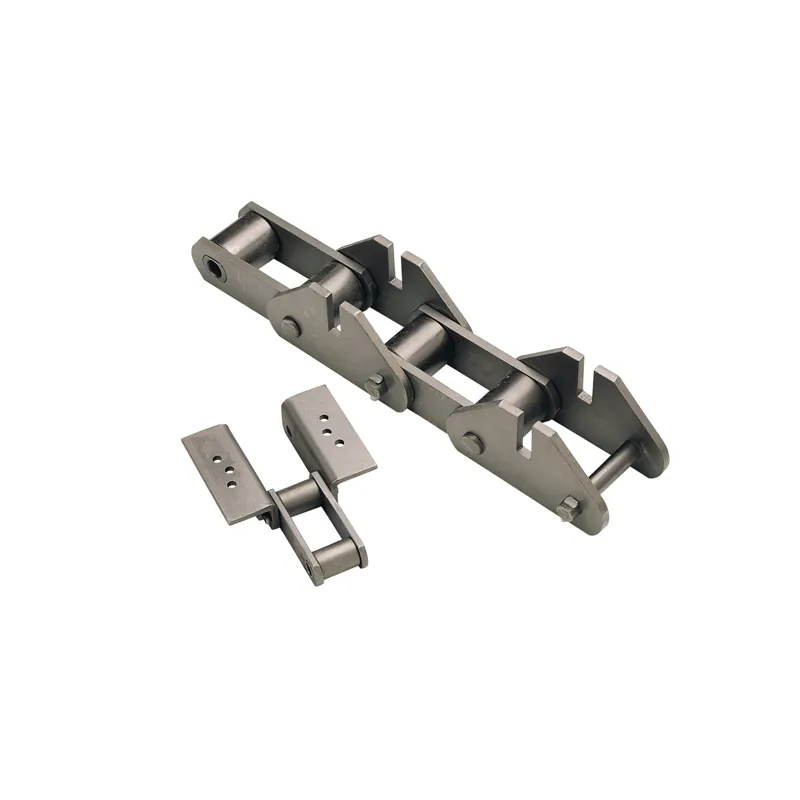
What are the common industries that utilize pintle chains?
Pintle chains find extensive usage in various industrial sectors due to their durability, strength, and versatility. Below are some of the common industries that utilize pintle chains:
1. Agriculture:
Pintle chains are commonly used in agricultural equipment, such as combines, harvesters, and balers. They assist in conveying and processing crops and agricultural materials efficiently.
2. Construction:
In the construction industry, pintle chains are employed in heavy-duty equipment like excavators, bulldozers, and loaders to move and handle construction materials and debris.
3. Forestry:
Pintle chains are utilized in forestry equipment, such as chainsaws and log debarkers, to handle timber and wood processing tasks.
4. Material Handling:
Pintle chains are widely used in material handling equipment and conveyor systems, facilitating the movement of goods and products in warehouses and distribution centers.
5. Mining:
In the mining industry, pintle chains are employed in mining machinery to transport heavy loads of ores and minerals from extraction points to processing areas.
6. Automotive:
Pintle chains are found in automotive assembly lines, providing reliable and efficient transportation of car parts during the manufacturing process.
7. Recycling:
In recycling facilities, pintle chains are used in recycling equipment to process and handle various types of recyclable materials.
8. Food Processing:
Pintle chains are utilized in food processing equipment, especially in applications where robust and hygienic conveyance of food products is essential.
9. Pulp and Paper:
Pintle chains are employed in pulp and paper mills to transport wood chips, pulp, and paper rolls during the manufacturing process.
10. Packaging:
In the packaging industry, pintle chains are utilized in packaging machines and palletizers to handle and transport packaged goods efficiently.
11. Bottling and Beverage:
Pintle chains are used in bottling and beverage production lines to convey bottles and cans during the filling and packaging process.
12. Aerospace:
In the aerospace industry, pintle chains find application in manufacturing processes, moving components and parts through various stages of assembly.
13. Energy:
Pintle chains are used in energy generation facilities, such as power plants, to handle and transport fuel materials.
14. Chemical:
In chemical processing plants, pintle chains are employed in equipment to handle and convey various chemicals and raw materials.
15. Pharmaceuticals:
Pintle chains are used in pharmaceutical manufacturing and processing equipment, ensuring efficient and reliable movement of medications and products.
Overall, pintle chains are essential components in a wide range of industries, enabling efficient material handling, transportation, and processing tasks. Their robust design and reliable performance make them a preferred choice in many industrial applications.

Can pintle chains be used in automotive manufacturing and assembly lines?
Yes, pintle chains can be used in automotive manufacturing and assembly lines for various applications. The automotive industry requires robust and reliable conveyor systems to handle the assembly of car components efficiently. Pintle chains offer several advantages that make them suitable for these demanding applications:
- Heavy-Duty Performance: Pintle chains are designed to handle heavy loads and provide reliable performance, making them ideal for carrying automotive components along the assembly line.
- High Tensile Strength: These chains have high tensile strength, which allows them to withstand the stress and pressure of conveying car parts through the production process.
- Flexibility: Pintle chains are flexible, allowing them to navigate around corners and accommodate complex conveyor layouts commonly found in automotive assembly lines.
- Durability: Automotive manufacturing involves continuous operation, and pintle chains’ durable construction can withstand the wear and tear of repetitive motion.
- Wide Range of Attachments: Pintle chains can be customized with various attachments, such as slats or fixtures, to securely hold and convey different automotive components during the assembly process.
From welding and painting to final assembly, pintle chains play a crucial role in moving car parts along the production line efficiently and precisely. Their ability to handle heavy loads and provide reliable performance makes them an excellent choice for automotive manufacturing and assembly lines.
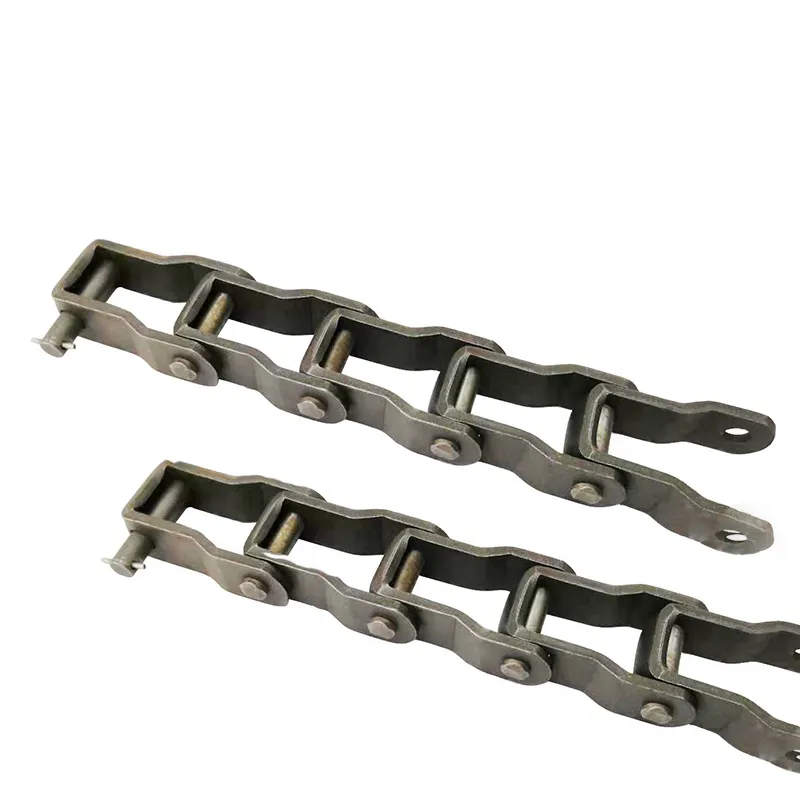
Can pintle chains be used in high-temperature environments?
Yes, pintle chains can be used in high-temperature environments, but the specific temperature range they can withstand depends on the material they are made of. Here’s a more detailed explanation:
Material Selection: Pintle chains are available in various materials, including carbon steel, stainless steel, alloy steel, and plastic. Each material has its temperature limits:
- Carbon Steel: Standard carbon steel pintle chains have a temperature range of around 150°C to 400°C (302°F to 752°F). They may lose some strength at higher temperatures and may not be suitable for extremely high-temperature applications.
- Stainless Steel: Stainless steel pintle chains offer better heat resistance and can handle temperatures ranging from approximately 200°C to 600°C (392°F to 1112°F). The exact temperature range depends on the specific grade of stainless steel used.
- Alloy Steel: Alloy steel pintle chains may have higher temperature capabilities compared to standard carbon steel chains, but the temperature range can vary based on the specific alloy composition.
- Plastic: Plastic pintle chains, especially those made from high-temperature engineering plastics, can handle temperatures up to around 250°C (482°F) and are suitable for some high-temperature applications.
Application Considerations: When using pintle chains in high-temperature environments, it’s essential to consider other factors as well:
- Lubrication: High temperatures can accelerate chain wear, so proper lubrication is crucial to reduce friction and wear. Choose lubricants that can withstand the operating temperature.
- Thermal Expansion: Materials can expand at high temperatures, so account for thermal expansion in the design of the chain and system.
- Application Limitations: Even with suitable materials, there may be limitations on the application’s speed, load capacity, and continuous operation time at high temperatures. Consult the manufacturer’s documentation for specific temperature-related limitations.
Conclusion: Pintle chains made from appropriate materials, such as stainless steel or high-temperature plastics, can be used in high-temperature environments. It’s essential to select the right material and consider other factors like lubrication and thermal expansion to ensure the pintle chain performs reliably and safely in these conditions.


editor by CX 2023-12-07